The Clinical Ready™ Dental Assisting Curriculum
Stop Selling Academic Completion to Students.
Start Selling Clinical Proof.
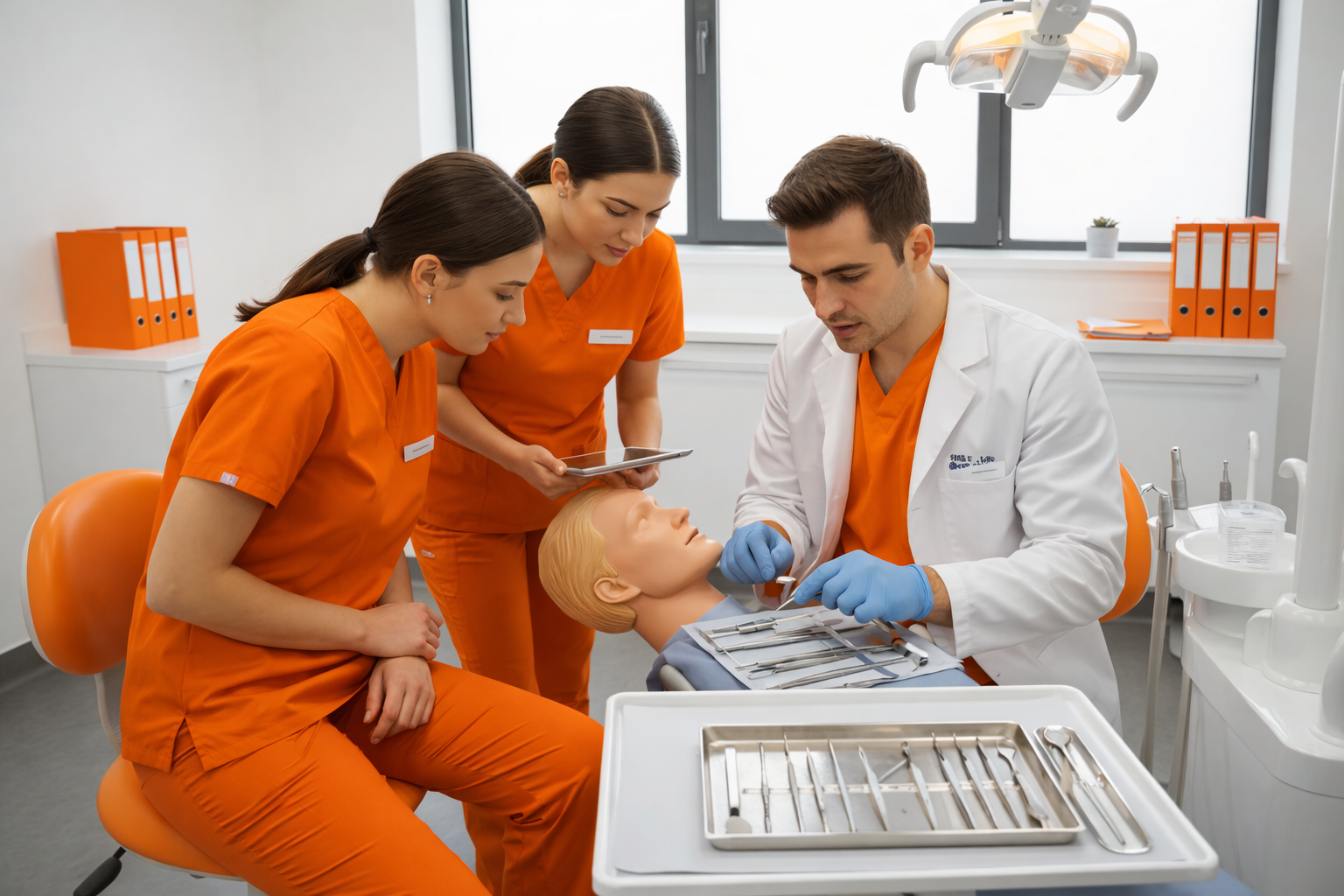
Clinical Ready™ isn’t a class your students simply complete. It is a validation system that proves they can perform in a real dental operatory.
Most dental assisting programs award grades for knowledge, attendance, and participation, then hope clinical competence follows. Clinical Ready™ uses a different standard. Students learn the skill, practice the skill, and then must pass a real performance gate before they move on. No averaging. No partial-credit mindset. No advancing because they sat through class. If the student cannot perform the task independently, they remediate and re-test until they can.
The result is a graduate who is not just academically complete, but clinically dependable—someone a dental practice can trust in real workflow, under real pressure, and to real standards.
Why It Matters
- Produces graduates who are more reliable in real workflow
- Builds safer habits under real operatory pressure
- Creates stronger employer confidence in graduate performance
- Separates clinical competence from academic seat time
- Gives schools a more marketable, practice-relevant training model
How the
Clinical Ready™ Curriculum Works
01
Students Learn the DA and Clinical Ready theory on 2 separate platforms: (online didactic)
Short online modules and textbook reading assignments are aligned to real clinical workflow and reinforced with knowledge checks. Partners receive access to two LMS platforms: one dedicated to Clinical Ready™ pre-lab preparation and skill-readiness concepts, and a separate dental assisting theory platform for foundational academic knowledge.
02
Convert theory into performance (Saturday labs):
Hands-on, instructor-guided drills with built-in challenge scenarios that expose mistakes, inconsistency, and skill drift early.
03
Validate with pass/fail gates:
A gate is not a practice round. It is a validation point. The student must perform independently while the instructor observes only—without prompting, hinting, or stepping in.
04
Harden under live flow (clinic blocks):
Students repeat previously validated skills in real workflow conditions to build consistency and reliability. Performance is documented to verify the skill remains stable under real clinical pressure.
05
Remediate and re-attempt until stable:
Any failed skill is documented, remediated, and re-tested. The student does not advance until the performance meets standard.
06
Final Practical Clinical Validation
(6 stations) for externship readiness:
Before entering paid externship and qualifying for graduation, students must pass a six-station practical exam built around the most critical clinical skills and highest-stakes performance standards.
Clinical Ready™ Certified Instructor Authorization
Clinical Ready™ is not a curriculum instructors interpret on their own. It is a validated training system delivered only by instructors who complete Smart Medical Ventures’ Clinical Ready™ Instructor Certification Program. Every certified instructor is trained to teach, observe, document, remediate, and enforce the model the same way, so standards remain consistent, defensible, and clinic-relevant across every cohort and campus. The result is less training drift, stronger quality control, and graduates who are truly prepared for real operatory workflow.
What the Clinical Ready™ Instructor Certification Program Ensures
- Consistent delivery of the Clinical Ready™ curriculum with no improvisation
- Standardized pass/fail gate enforcement using observe-only validation
- Objective documentation for every skill validation and progression decision
- Clear remediation protocols that prevent soft-passing or inconsistent advancement
- Clinic-aligned performance standards that protect patient safety, workflow reliability, and practice throughput
We Provide All State Board Program Change Submission Documents
Clinical Ready™ curriculum adoption includes alignment of your state board submission materials so the program can be presented as a program change rather than a new license application where appropriate. We help structure the required academic and compliance documents to match your state-specific framework, including catalog language, syllabus sets, lesson plans, clock-hour breakdowns, course descriptions, and related program documentation, so your submission package is organized, consistent, and ready for review.
Where applicable, Clinical Ready™ curriculum is submitted as a program change application—not a full new license application. That usually makes approval simpler, faster, and far less burdensome, while still aligning your catalog, syllabus, lesson plans, and supporting documents to state-specific board requirements.
Weekly Dental Assisting Clinical Ready™ Course Outline
Week 01
Operatory Foundations + Authorization
Students are first trained on the fundamentals: role responsibilities, operatory organization, tray systems, core instrument groups, and professional behavior. Before they are allowed into performance labs, they must pass an authorization gate that confirms they understand these basics and are ready to train safely and correctly.
Week 02
Safety + Dentition +
Charting Readiness
Students must demonstrate accuracy in tooth numbering, charting, PPE order, contamination control, and tray/instrument readiness before they are cleared to advance to the next phase of training.
Week 03
Instruments + Tray Systems
+ Chairside Flow I
This phase trains students to identify instruments in real workflow, build the complete tray setup for the procedure, perform a final readiness check before seating the patient, position the operatory correctly, and execute baseline transfers; students must pass the DA103 gate before advancing to in-clinic blocks, where they begin reinforcing already-validated skills inside real practice workflow under supervision.
Week 04
Four-Handed + Isolation Fundamentals
This phase trains students on suction and retraction timing, ergonomic positioning, recognizing when isolation begins to break down, and correcting contamination risks in real time; they must pass the DA104 gate before advancing, while clinic blocks continue to harden these already-validated skills under real workflow conditions.
Week 05
Infection Control Certification
+ Turnover Reliability
This phase includes completion of the Infection Control certificate and training on a zero-tolerance operatory turnover system built around clear zoning and contamination control points; students must pass the DA105 Turnover Gate to advance, and this component is structured to meet all state dental boards including Dental Board of California standards.
Week 06
Materials Timing +
Defect Prevention
This phase trains students on proper material mixing discipline, timing control, early defect recognition such as voids, pulls, or distortion, and how to correct problems without relying on provider rescue; they must pass the DA106 gate before advancing, while clinic blocks continue reinforcing these skills under real workflow conditions.
Week 07
Radiology Didactic +
12-Hr Manikin Intensive
This phase trains students on first-pass radiographic positioning for bitewings and periapicals, proper FMX and bitewing sequencing, retake prevention habits, and imaging infection control; they must pass the DA107 gate before advancing, with live-patient radiographic exposures tracked separately.
Week 08
Image Quality +
Retake Judgment
This phase trains students to distinguish diagnostic from nondiagnostic images, identify common errors, make correct accept-or-reject decisions, and apply the right retake and correction strategy; they must pass the DA108 gate before advancing, while clinic blocks continue reinforcing these skills under real workflow conditions.
Week 09
Restorative Support + Isolation Mastery
This phase trains students to maintain moisture control under sustained workflow, anticipate procedural needs without constant prompting, recognize and recover from contamination risks, and support restorative flow with consistency and reliability; they must pass the DA109 gate before advancing, while the final clinic block reinforces these skills under real practice conditions.
Week 10
Crown/Bridge + Finals Practical (Externship Clearance)
This phase trains students on crown and cementation staging, sequence discipline, and cleanup verification, while also introducing basic iTero scan awareness, including foundational scan path and what an acceptable scan looks like; students must then pass a six-station final practical validation to be cleared for paid externship.
Week 11
iTero Scanning + Digital Dentistry (Hardening + Externship)
This phase builds iTero scanning discipline, including proper scan path, recognizing scan defects, knowing when a rescan is needed, and maintaining infection control during scanning; an 8-hour Saturday Hardening Lab reinforces these skills while externship continues.
Week 12
Hardening Lab + Final Audit + Externship Complete
This phase brings the full Clinical Ready™ system together through complete workflow simulation, chart closure discipline, completion auditing, and portfolio artifact collection; an 8-hour Saturday Hardening Lab reinforces final performance standards while externship is brought to completion.
What a Clinical Ready™ Graduate Brings to Any Practice
A graduate who can reliably execute the fundamentals that protect workflow, reduce errors, and support production:
- Tray preflight discipline so setups are complete before the procedure begins, with less late discovery and less mid-procedure hunting
- Instrument readiness and request-response flow with cleaner handoffs, less hesitation, and fewer wrong passes
- Operatory zoning and control point discipline to reduce contamination drift and support safer clinical flow
- Suction and retraction timing that helps maintain field visibility and procedural stability during treatment
- Early isolation drift recognition so breakdowns are caught and corrected before they create larger clinical problems
- Documentation accuracy that supports cleaner handoffs, fewer re-checks, and better workflow closure
- A first-pass radiography mindset focused on positioning discipline, retake prevention, and California-aligned imaging habits
- Turnover reliability with a repeatable operatory reset system, including infection control training built into the program