Clinical Ready™ Curriculum Adoption
for Dental Assisting Schools

Stop Competing With the Same Academic Curriculum Everyone Else Is Using
Most dental assisting schools still rely on the same academic formula: lectures, grades, and hour completion. Clinical-Ready™ gives dentist-owned schools a stronger hybrid model built around pass/fail validations, re-checks, instructor certification, and clearer externship readiness—so you can produce more consistent, practice-ready graduates and stand apart from traditional programs.
The result is a stronger curriculum, a stronger graduate story, and a more defensible way to show that your students are being trained for real clinical performance, not just academic completion.
- Move beyond lectures, test scores, and C-average completion
- Differentiate your school from traditional academic competitors
- Build more consistent graduate performance through validation gates and re-checks
- Strengthen instructor consistency through certification and structured delivery systems
- Give practices more confidence in the readiness of your graduates
- Upgrade your program through curriculum adoption instead of building a new school from scratch
Compare Curriculum Models
Academic structure uses grading for knowledge and skill progression. Clinical-Ready uses validation for high-reliability performance in practice.
Academic Progression (graded) vs Clinical-Ready™ Validation (PASS/FAIL)
Dentistry is not a classroom. “Mostly correct” still produces failures. Our Clinical-Ready™ model validates reliability to a standard so practices get clinic-ready performance—not a letter grade.
| Category | Traditional Grading (Academic) | Clinical-Ready™ PASS/FAIL (Validation) |
|---|---|---|
| What it measures | Knowledge + partial skill completion | Reliability and readiness in high-risk domains |
| Progression | Students advance with averages | Students advance only when validated to standard |
| “Almost competent” | Often passes | Not acceptable—must meet the standard |
| Safety & compliance | Can be diluted by overall grades | Non-negotiable: critical failures do not pass |
| Remediation | Optional or delayed | Immediate correction + revalidation before progressing |
| Clinical readiness | Variable by instructor/program | Standardized, enforceable outcomes |
| Practice impact | Graduates often require retraining | Prepared for structured onboarding and faster productivity |
| Employer confidence | Mixed | Higher—because performance is proven, not inferred |
Clinical-Ready™ Hybrid Dental Assisting Program (12 Weeks)
The only role-based, hybrid Dental Assisting pathway built for real clinic performance—not academic completion.
Not a traditional academic program. This is a Clinical-Ready pathway engineered inside real practices to prevent the operational failures that break general dentistry.
Practice-level impact
- Reduced provider takeover and chairside interruptions
- Fewer preventable retakes, remakes, and delays
- Stronger infection control and turnover consistency
- Faster onboarding into dependable performance
- Higher team confidence and patient trust

How the Clinical Edge Clinical-Ready Pathway Works
12 weeks. Hybrid delivery. Pass/Fail skill gates with re-check required
Phase 1: Foundations (Weeks 1–3)
Students build the baseline habits, language, and discipline needed for safe, consistent chairside performance. This phase focuses on operatory communication, procedural vocabulary, documentation habits, infection control basics, and the readiness behaviors required before formal validation begins.
Phase 2: Validation (Weeks 4–9)
Students complete supervised pass/fail validations in the clinical domains that most often drive practice breakdowns. This phase emphasizes quality, compliance, and speed standards through role-based skill gates, repeatable checklists, and re-checks until performance is demonstrated under real time pressure.
Phase 3: Externship Readiness (Weeks 10–12)
Students transition into real clinical participation with defined expectations, performance tracking, and reliability standards. This phase focuses on supervised participation, remediation where needed, and the clearance criteria required for externship readiness.
How the Pass/Fail Gates Work
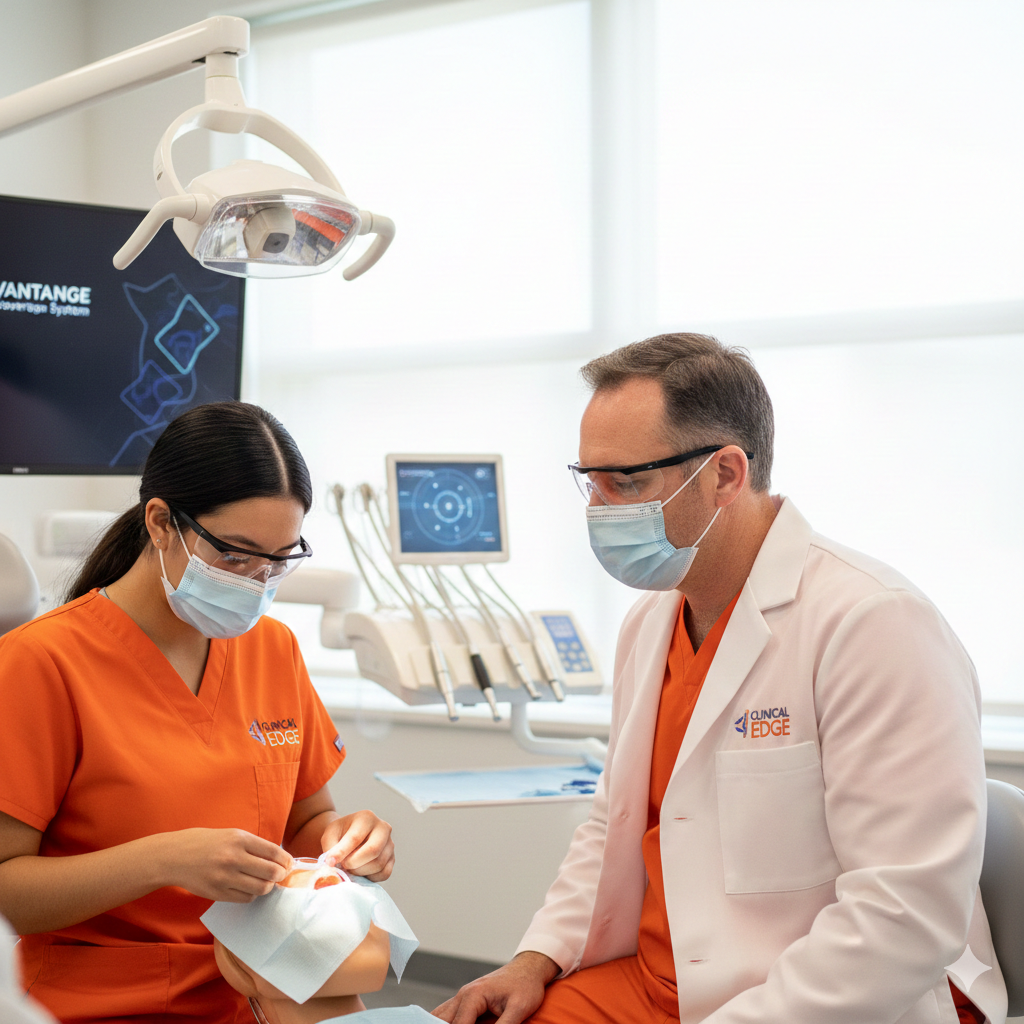
Clinical-Ready Gates are PASS/FAIL performance validations completed in controlled lab and supervised clinical environments. A Gate isn’t a quiz or a grade—it’s proof a student can execute to standard without drift.
What gates accomplish operationally
- Prevent “almost-competent” progression in high-risk domains
- Reduce chairside breakdowns, retakes/remakes, and provider takeover
- Enforce consistency under pace and pressure (not just knowledge)
- Protect safety/compliance and reduce downstream documentation risk
How students pass the program
Students pass by repeatedly demonstrating:
- Safe, consistent performance in high-risk clinical domains
- Reliable workflow execution with minimal prompting
- Correct escalation and professionalism when uncertain
- Repeatable outcomes aligned to real practice standards
If a student fails a Gate, they don’t move forward—they remediate and re-attempt until they pass.
Weekly Clinical-Ready™ Course Outline
Week 1
Operatory Foundations + Readiness Authorization
Students build role clarity and learn operatory zones, tray categories, basic instrument families, and professionalism standards. A Pass/Fail Authorization Gate must be cleared before entering Performance Labs.
Week 2
Safety, Dentition, and Charting Readiness
Students build accuracy in tooth numbering, tooth surfaces, and charting from dictation while reinforcing PPE sequencing, clean versus contaminated control points, and tray and instrument refresh. A Pass/Fail Authorization Gate must be cleared before advancing.
Week 03
Instruments, Tray Systems, and Chairside Flow I
Students build recognition of instruments under flow, learn tray BOMs (the required supply list for an appointment), complete preflight readiness checks before seating the patient, and practice chair and stool positioning with baseline transfers. A Pass/Fail DA103 Gate must be cleared, and in-clinic blocks begin this week.
Week 4
Four-Handed Dentistry and Isolation Fundamentals
Students strengthen suction and retraction timing, operatory ergonomics, isolation control, recognition of isolation drift, and contamination recovery behaviors. A Pass/Fail DA104 Gate must be cleared, with continued hardening through clinic blocks.
Week 5
Infection Control Certification + Turnover Reliability
Students complete the Infection Control certification component while strengthening operatory turnover systems built around zero-tolerance zoning and control points. A Pass/Fail DA105 Turnover Gate must be cleared. This module is designed to meet Dental Board of California standards.
Week 6
Materials Timing +
Defect Prevention
Students strengthen mixing discipline, timing control, and recognition of common material defects such as voids, pulls, and distortion. They also learn how to take corrective action without relying on provider rescue. A Pass/Fail DA106 Gate must be cleared, with continued hardening through clinic blocks.
Week 7
Four-Handed Dentistry and Isolation Fundamentals
Students strengthen suction and retraction timing, operatory ergonomics, isolation control, recognition of isolation drift, and contamination recovery behaviors. A Pass/Fail DA104 Gate must be cleared, with continued hardening through clinic blocks.
Week 8
Infection Control Certification + Turnover Reliability
Students complete the Infection Control certification component while strengthening operatory turnover systems built around zero-tolerance zoning and control points. A Pass/Fail DA105 Turnover Gate must be cleared. This module is designed to meet Dental Board of California standards.
Week 9
Materials Timing +
Defect Prevention
Students strengthen mixing discipline, timing control, and recognition of common material defects such as voids, pulls, and distortion. They also learn how to take corrective action without relying on provider rescue. A Pass/Fail DA106 Gate must be cleared, with continued hardening through clinic blocks.
Paid Externships That Drive Enrollment Demand
Students enroll when there’s a paycheck on the path—employers pay when performance is proven.
Validated Externship Readiness
Paid externships increase enrollment by creating a credible path to income. Our students qualify because they’re validated for reliability before entering real production pace—so practices can confidently compensate within a defined scope. Most traditional dental assisting academic programs default to unpaid externships because students require constant correction, which costs the practice time, disruption, and risk.
Externship Readiness Employers Pay For
Paid roles are always defined-scope and supervised; readiness is validated before participation increases. Our Clinical-Ready gates validate reliability before students enter real production pace.
Validated before externship
Before entering externship, students must demonstrate reliable performance in the clinical habits that matter most in a real practice. This includes infection control and turnover discipline under active clinical movement, more consistent diagnostic workflow support with fewer retakes, and stronger setup and chairside flow to reduce interruptions and rework.
Why employers pay
- Less hidden cost from constant corrections and slowdowns
- Predictable room transitions and throughput support
- Protected compliance, patient trust, and team confidence
- Paid externships are market-dependent and not guaranteed; validation makes compensation possible.
*Externship placements are subject to availability and practice participation.
Clinical Edge does not guarantee externship compensation or employment.
Compensation terms, if any, are solely between the student and the hosting practice.
Ready to see which track fits your practice?
Academy FAQ
What’s the difference between Clinical-Ready™ and a traditional academic curriculum?
Clinical-Ready™ is built around demonstrated performance, not just course completion. Students move through pass/not yet skill gates, must re-check when needed, and are expected to show reliable execution before advancing into externship or higher-responsibility clinical participation.
A traditional academic curriculum is typically built around lectures, assignments, quizzes, and hour completion. Students may finish the program having been exposed to the material, but without the same level of repeated validation in the failure points that most often create problems inside a real practice.
Clinical-Ready™ is designed to produce stronger role readiness through structured validation, remediation, and repeatable performance standards. Traditional academic models are often more flexible, but they are usually less focused on proving that students can perform consistently under real clinical conditions.
If my current academic program is already graduating students, why would I switch to Clinical-Ready™?
Because most traditional academic programs are built to graduate students who pass courses, not to validate whether they can perform at a higher clinical level. In many schools, students move through with C averages, complete the required hours, and graduate with C-average habits, C-average consistency, and C-average execution.
That does not mean they are bad students. It means the system is often designed around academic completion more than proven role readiness.
Clinical-Ready™ is different. It is built to push beyond lecture grades and course averages by requiring students to demonstrate performance through pass/not yet skill gates, re-checks, and clearer readiness standards in the areas that most often break down in real practice.
So the reason to switch is not simply to graduate students. It is to stop accepting average performance as enough. Clinical-Ready™ is designed to produce stronger consistency, stronger habits, and a more reliable clinical standard than the traditional academic model most schools still use.
Can I use my own school name with the Clinical-Ready™ curriculum?
Yes. You can operate under your own school name, but to fully differentiate the program, we strongly recommend using our approved marketing collateral and positioning language on your website and promotional materials so the value of the Clinical-Ready™ model is communicated clearly and consistently.
What does “gated” mean in the Growth plan?
“Gated” means students do not move forward just because they attended, completed hours, or passed a written test. They must demonstrate the required skill or performance standard before advancing.
In the Clinical-Ready™ model, this means students must pass specific role-readiness checkpoints. If they do not meet the standard, they are re-checked after remediation until they do. The goal is to prevent students from progressing with weak habits, inconsistent execution, or unresolved skill gaps.
Is Starter “easier” than Growth?
Territory protection is built in to help preserve the value of the model for partner schools. If the same curriculum is placed too closely across nearby markets, it becomes harder for any one school to stand out and fully benefit from the differentiation the program is designed to create.
It also helps protect the integrity of the opportunity for the school owner making the investment. The goal is not to oversaturate an area with the same offering, but to give each partner a clearer position in their market while they build enrollment, reputation, and employer recognition around the curriculum.
What’s included in the Clinical-Ready™ curriculum package?
The curriculum package includes the core academic and operational materials needed to deliver and position the program effectively. This includes Clinical-Ready™ curriculum outlines, syllabi, lesson plans, catalog course descriptions, course progression charts, and an hour-by-hour teaching guide to support delivery.
It also includes access to two online LMS platforms: one for foundational dental theory and knowledge, and one for the Clinical-Ready™ learning platform itself. In addition, the package includes LMS-integrated validation checklists, the instructor certification course, website page content, and state-specific program change submission documents to support board or regulatory review where applicable.
Who is curriculum adoption designed for?
Curriculum adoption is designed for existing licensed dental assisting schools that want to strengthen or replace their current training model with a more differentiated curriculum. It is especially relevant for school owners who want a stronger practice-readiness model, better performance standards, and a clearer way to stand apart from traditional academic programs.
What kind of support do I get after launch?
After launch, support continues around curriculum implementation, instructor consistency, program updates, and the ongoing materials tied to the Clinical-Ready™ model. This includes access to the LMS platforms, validation systems, and guidance needed to help maintain alignment with how the curriculum is designed to be delivered.
Trusted by dental societies and clinical education partners.
