Why Clinical Edge Exists
Clinical Onboarding OS Team Hardening and Clinical Ready™ Curriculum Adoption for Dental Assisting Schools
Clinical Ready™ exists for two types of dentist-owners:
1. Dentists who need a stronger onboarding and staff hardening system inside the practice, and
2. Dentists who own a dental assisting school and want a better curriculum model with better real-world results
In both settings, the problem is often the same: training is still built on a weak formula of information first, performance later. New hires sit through explanations, staff are told to shadow, students pass quizzes, and everyone hopes real competence will eventually show up in the operatory. Too often, it does not.
That is where Clinical Ready™ is different.
For dentist-owned dental assisting schools, Clinical Ready™ Curriculum provides a much stronger curriculum package than the traditional academic model. Instead of centering the program around lecture, grade averages, and theory-heavy progression, it is built around clinical usefulness, role-based skill development, and the standards practices are actually hiring for. That gives school owners a better answer to what makes their program different, more relevant, and more valuable to both students and the dentists who may employ them.
For dental practices, Clinical Ready™ OS provides a more structured, DSO-style onboarding and hardening system designed to help turn new hires and existing team members into stronger clinical assets. Instead of relying on loose shadowing, inconsistent coaching, and tribal knowledge, the model focuses on role-based training, workflow discipline, chairside expectations, and repeatable clinical performance standards that actually matter in a live practice.
Dental Assisting School Clinical Ready™ Curriculum Adoption
Requires eligibility + territory availability. For schools that qualify only. See Pricing
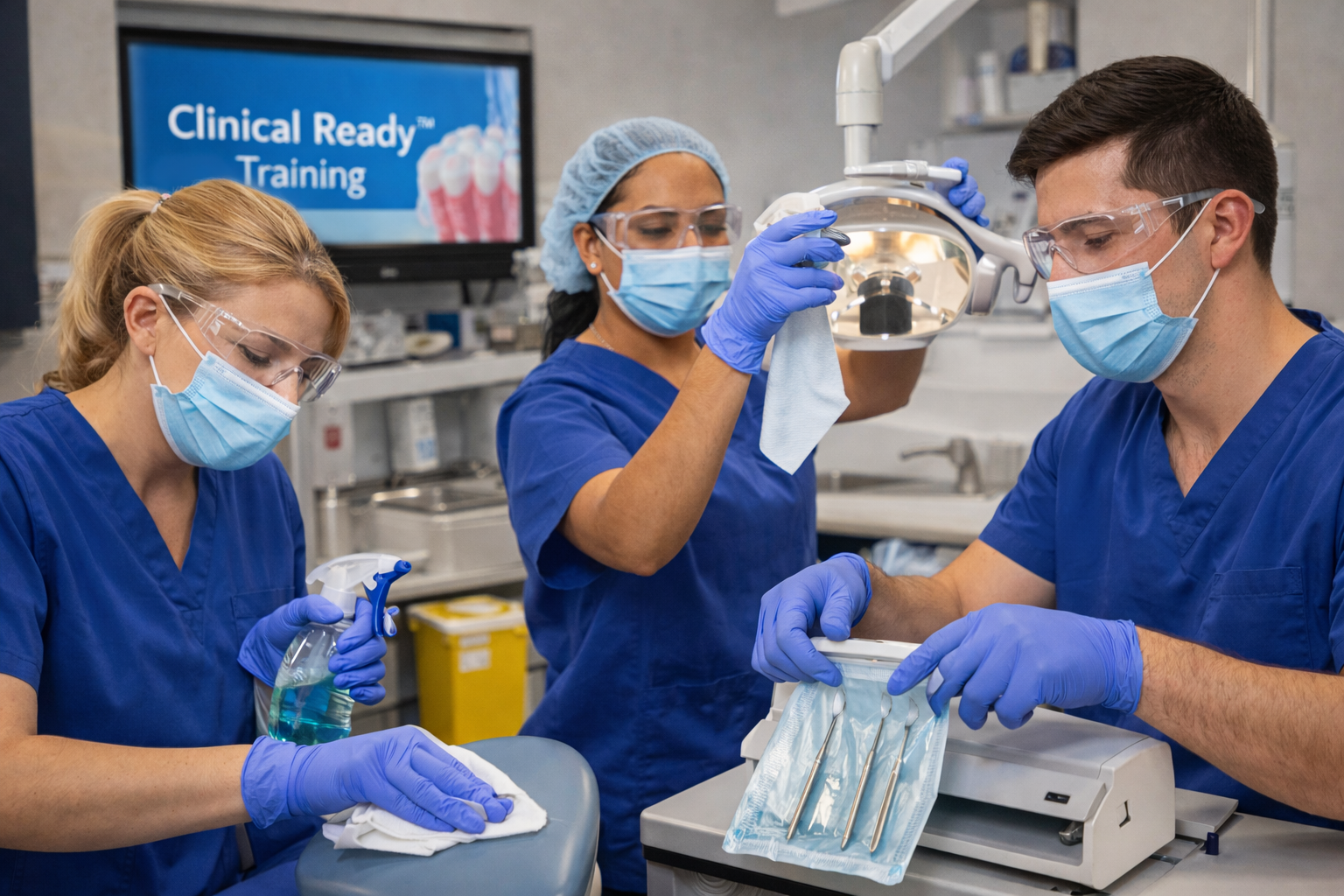
Move beyond academic completion. Offer students hire-ready, practice-relevant skills that dental offices can feel from day one.
If your dental assisting school is still built primarily around grades, theory, and generalized instruction, it becomes harder to stand out—and harder to show practices why your graduates are different.
Clinical Ready™ Curriculum Adoption allows select schools to implement a more practice-relevant, performance-based training model built around real operatory standards. It is designed to help your program move beyond lecture-heavy education and toward something more defensible, more marketable, and more aligned with what employers actually value: reliability, readiness, and chairside usefulness.
For schools that want stronger positioning, better employer credibility, and graduates who feel more job-ready in real workflow, Clinical Ready™ offers a more compelling model.
Built for schools that want:
- meaningful differentiation
- stronger employer relevance
- better graduate marketability
- more clinically useful training outcomes
- a curriculum aligned with real practice expectations
The "Traditional Academic Curriculum" (The Old Way) ❌
Students finish courses, but practices often still have to close the gap between academic completion and real clinical usefulness.
- Theory-heavy instruction first with the expectation that real clinical usefulness will come later
- Grades, attendance, and participation used as the main indicators of progress
- Students move forward by averaging performance instead of proving independent skill execution
- Clinical inconsistency is tolerated as long as academic scores remain acceptable
- Employers inherit the gap and must retrain graduates for real operatory workflow
- Schools compete with the same promise as other lecture-heavy programs in a crowded market
- Graduates may be academically complete but still unreliable in real chairside conditions
Clinical Ready™ Curriculum (The New Way) ✅
Workflow-relevant. Students do not just complete the program—they prove they can perform to standard before advancing.
- Practice-relevant training from the start built around real operatory workflow
- Pass/fail performance gates used to validate skill execution, not just knowledge retention
- Students advance only after proving the standard independently
- No soft-passing, averaging, or rescue-based progression
- Skill drift, contamination errors, retake habits, and weak workflow behaviors are identified and corrected early
- Schools offer a more defensible and differentiated training model in the market
- Graduates leave more clinically useful, more reliable, and more credible to employers
See Eligibility Rules:
The Clinical Edge Onboarding and Hardening System
The Hiring and Revenue Advantages of a
Structured Clinical Training System
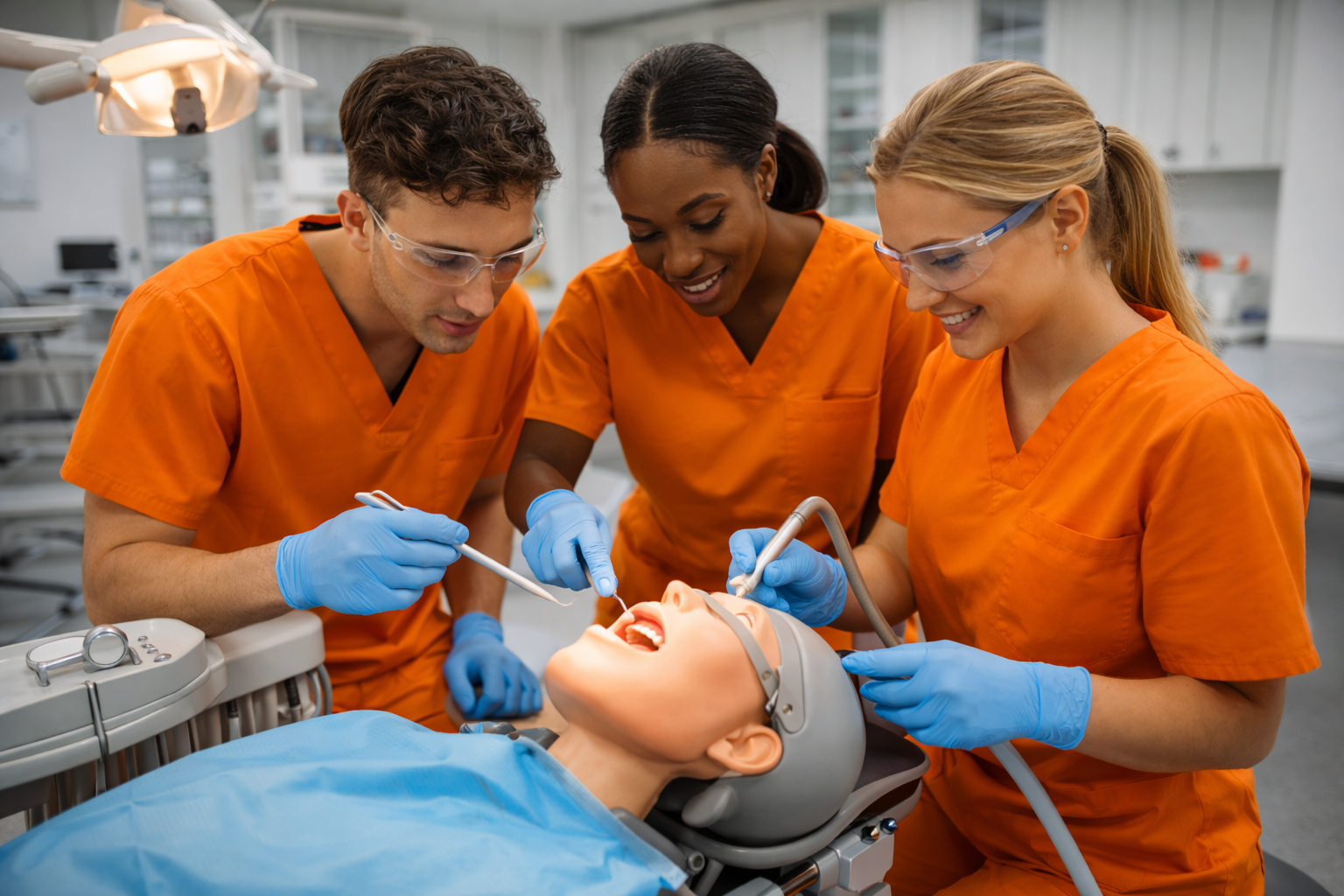
DSO-Style Onboarding and Hardening System
Most practices still spend 20+ hours chasing “maybe” hires, then lose another 8 to 12 weeks while new team members slowly ramp up. Clinical Edge replaces that with a DSO-style onboarding and hardening system built inside your practice, without giving up your independence.
New hires and existing staff move through a structured model designed to strengthen reliability, reduce preventable failure, and help protect up to $200,000 in revenue leakage. Instead of buying labor and hoping it works, you build your own elite assistant pipeline.
The "Hiring" Cycle (The Old Way) ❌
- 20+ hours lost screening and interviewing “maybe” hires
- 8–12 week lag before a new hire becomes productive
- Ongoing production drag during informal onboarding
- Market wages paid while the practice carries the training burden
Clinical Edge (The New Way) ✅
- Structured in-practice onboarding for new hires and existing staff
- A repeatable internal talent pipeline, not just outside recruiting
- Reduced failure-related leakage across workflow, radiography, turnover, and clinical support
- A stronger path to reliability, throughput, and profit protection