
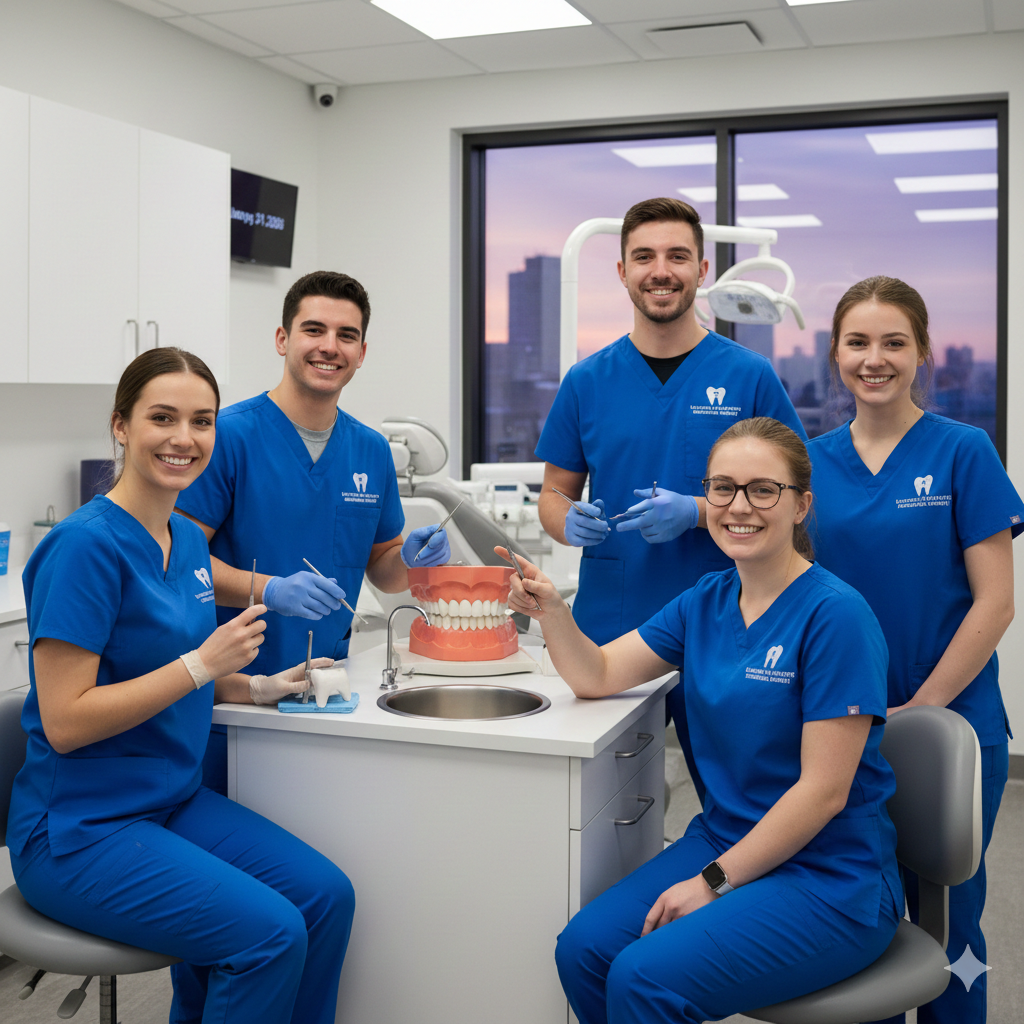
DSO-Grade Onboarding and Pass/Fail Validation That Survives Turnover—Without Losing Independence
Role-based readiness gates and 30/60/90-day hardening help your practice grow with stronger consistency, fewer clinical and administrative breakdowns, and less dependence on whether a single hire “just works.” The result is a more reliable team foundation that supports higher revenue, smoother operations, and fewer preventable failures as the practice scales.
- Reduce chairside interruptions and provider takeover
- Fewer retakes, remakes, and preventable rework
- Faster onboarding into dependable performance
- Cleaner handoffs, documentation, and consistency across rooms
- Standards stay stable even when staffing changes
Reliability is the symptom. Onboarding is the root cause.
Most practices do not lose performance all at once. They lose it through small, recurring breakdowns in chairside flow, handoffs, scheduling, and admin execution that compound into rework, lost capacity, and collections drag. Clinical Edge installs role-based readiness gates and 30/60/90-day hardening so standards stay stable even when staffing changes.
The recurring failures that create leakage:
- Doctor rescue and chairside stall points
- Retakes, remakes, and rework loops
- Turnover that resets standards
- Scheduling drift that creates holes
- Admin inconsistency that slows collections and follow-up
Why onboarding becomes a revenue killer:
- Shadowing trap: bad habits get copied and normalized
- 90-day burnout: overwhelm turns into quitting/ghosting
- No enforcement: standards become optional without gates

Implementation is finite. Staffing is ongoing.
If onboarding isn’t a system, your standards decay
—and revenue plateaus.
How Clinical Reliability OS Works
A simple pipeline: credential, authorize, and keep standards stable.
01
Certify Your In-Practice Validator
Before staff move through readiness gates, one internal validator is credentialed inside your practice so standards do not depend on who happens to be training that week.
- Instructor Platform
- Validator playbook
- Pass/Fail gate rules
- Calibration rubric
- Evidence requirements and sign-offs
- Bundle-based checklists
Output: Your practice has a defined internal validator who can clear staff against a consistent standard.
02
Authorize Roles Through Readiness Gates
Each role moves through a structured track with Pass/Not Yet gates tied to the failure domains that create clinical and administrative leakage.
- New hires: baseline to supervised scope to independent authorization
- Existing staff: audit gate with targeted remediation where needed
- Externs: defined scope and proof before expanded responsibility
Output:
Every role is cleared to a defined scope by proof, not assumption.
03
Keep Standards Stable Through Re-Validation
Initial implementation is finite, but staffing changes are ongoing. Re-validation keeps standards from drifting after turnover, role changes, and day-to-day operational pressure.
- 30/60/90-day re-validation scorecards
- Lightweight audit loops across clinical and admin functions
- Re-calibration and updates to maintain consistency
- Ongoing hardening after authorization
Output: Standards stay stable even when staffing changes.
Role Tracks Library
Your subscription includes access to all role tracks.
Where Most Practices Start
Most practices begin by enforcing the tracks tied to their biggest leakage points first:
Clinical Reliability, Hygiene Performance, Front Desk, or Admin Ops.
Clinical Reliability
This track protects chair time by strengthening the clinical systems that keep procedures moving consistently, including chairside assisting, imaging, sterilization and turnover, and where applicable, scanning and crown and bridge support. It is designed to reduce doctor rescues, slowdowns, retakes, remakes, room downtime, and contamination risk through more reliable day-to-day execution.
Chairside Reliability Track
Outcome:
The assistant clears core chairside gates and stops doctor rescues.
Includes:
- Procedure setup standards
- four-handed transfers
- suction timing
- anticipation sequencing
- chairside documentation handoff
- time-to-ready checkpoints
Prevents:
- Missing setup
- transfer/suction timing failures
- procedure stall points
- rework/remake triggersThe assistant clears the core chairside gates and stops the doctor from rescuing.
Imaging Reliability Track (FMX/BW)
Outcome:
Diagnostic-quality FMX/BW with minimal retakes
Includes:
- Positioning standards
- exposure consistency
- retake-prevention corrections
- image labeling/QC
- doctor handoff protocol
- pass/fail image set gate
Prevents:
- Cone-cuts/distortion
- inconsistent exposures
- mislabeled/failed image sets
- retake appointments
Sterilization & Turnover — Chain-of-Custody Track
Outcome:
Reliable sterile flow + consistent, compliant room turnover
Includes:
- Clean/dirty zoning
- instrument transport workflow
- load config standards
- wet-pack prevention
- spore test routine
- storage integrity
- turnover dwell-time sequence
Prevents:
- Zoning breaks
- wet packs/torn pouches
- incorrect loads
- missed dwell time
- room downtime
Restorative Support — Crown & Bridge Reliability Track
Outcome:
Smoother crown appointments and fewer remakes
Includes:
Crown/bridge tray standards
temporization support flow
impression/scan readiness
lab case handoff checklist
cementation support staging
remake-prevention checkpoints
Prevents:
Temp failures
impression/scan rejects
missing materials
lab handoff mistakes
chairside stalls
View All Tracks
Hygiene Reliability
This track helps stabilize hygiene production by strengthening perio consistency, restorative case tee-up, adjunctive service execution, hygiene assistant flow where used, and recall discipline. It is designed to reduce underdiagnosed perio, low case acceptance, recall leakage, and hygiene schedule volatility through a more consistent hygiene workflow.
Perio Reliability & Productivity Track
Outcome:
Consistent perio diagnosis + treatment execution with stable hygiene production
Includes:
- Probing/BOP capture standards
- perio classification rules (practice-defined)
- SRP/maintenance workflow
- exam handoff protocol
- documentation/billing minimums
- reactivation cadence basics
Prevents:
- Underdiagnosed perio
- inconsistent charting
- weak exam handoffs
- perio program revenue drift
Hygiene Assistant — Hygiene Support & Flow Track
Outcome:
Hygiene runs on time while hygienist stays focused on clinical care
Includes:
- Room turnover sequence
- setup/par standards
- imaging support flow (if allowed)
- charting assist workflow
- intraoral photo capture support
- exam readiness checklist
Prevents:
- Late starts
- turnover bottlenecks
- hygiene slowdown from nonclinical tasks
- exam delays
Assistant → Hygienist Handoff Protocol (Room + Patient Ready)
Outcome:
Hygienist receives a fully prepped room + complete patient context in under 15 seconds—visit starts on time
Includes:
- Visit type confirmation
- medical update flags
- required radiographs status + QC
- intraoral photo capture (if indicated)
- correct hygiene setup staged (prophy/perio/SRP)
- perio chart due flag + note template pre-loaded
- time-remaining callout
- standardized 15-second handoff script
Prevents:
- Late starts
- hygiene schedule drift
- missing/incorrect imaging
- incomplete charting prep
- room/setup scramble
- exam handoff delays
Restorative Identification & Pre-Doctor Conversation Track
Outcome:
Hygienist identifies restorative needs early and tees up the case with visual proof
Includes:
- Restorative red-flag checklist
- intraoral camera proof protocol
- concern + proof scripting (non-diagnostic)
- doctor handoff note template
- case tee-up timing standard
Prevents:
- Missed cracked teeth/failing restorations
- weak patient understanding
- low case acceptance
- doctor exam bottlenecks
View All Tracks
Admin/Ops Reliability
This bundle helps protect practice stability by strengthening the systems behind collections, coordination, accountability, follow-through, and day-to-day administrative execution. It is designed to reduce missed follow-up, collections leakage, administrative bottlenecks, communication breakdowns, and operational drift through more reliable back-office performance.
New Patient Intake & Conversion Track
Outcome:
More booked first visits with fewer cancellations and cleaner first-visit execution
Includes:
- Phone script + call flow
- online inquiry response SLA
- insurance snapshot intake
- appointment type rules
- pre-visit instructions
- confirmation + deposit policy (if used)
- first-visit checklist
Prevents:
- Lost leads
- wrong appointment types
- incomplete intake
- no-show risk
- day-of confusion
Eligibility & Benefits Verification Track
Outcome:
Fewer financial surprises and stronger collections at time of service
Includes:
- Verification checklist
- benefits breakdown template
- limitations/frequencies tracking
- remaining deductible logic
- coordination of benefits flags
- documentation minimums
- same-day escalation rules
Prevents:
- Write-offs from “we didn’t know”
- patient disputes
- broken estimates
- delayed treatment starts
Scheduling Template & Capacity Control Track
Outcome:
Predictable daily production with fewer holes and less chaos
Includes:
- Provider templates
- procedure time standards
- buffer rules
- same-day fill protocol
- short-call list system
- hygiene/doctor coordination rules
- protect prime time logic
Prevents:
- Underutilized chair time
- unstable schedules
- bottlenecks
- overtime patterns
- chronic running behind
Confirmation & No-Show Prevention Track
Outcome:
Reduced no-shows and stronger schedule reliability
Includes:
- Confirmation cadence (text/call/email)
- scripting
- two-way confirmation rules
- reschedule protocol
- deposit/credit card policy (if used)
- day-before/day-of recovery workflow
Prevents:
- No-show leakage
- last-minute holes
- staff time waste
- schedule volatility
View All Tracks
Front Desk Reliability
This bundle helps protect chair capacity by strengthening scheduling, confirmations, check-in accuracy, patient flow, and appointment conversion. It is designed to reduce schedule holes, no-show leakage, late starts, broken handoffs, idle chair time, and patient frustration through more reliable front desk execution.
Phone Intake & Appointment Conversion Track
Outcome:
More calls convert into booked appointments with correct scheduling and cleaner first-visit execution
Includes:
- call flow + scripting
- caller classification (NP / emergency / existing)
- appointment type rules
- insurance snapshot intake
- deposit policy (if used)
- pre-visit instructions + confirmations
- missed-call recovery protocol
Prevents:
- Lost leads
- wrong appointment types
- call handling inconsistency
- day-of confusion
- low conversion rate
Check-In Accuracy & Flow Track
Outcome:
Faster check-in with fewer billing errors and less chair downtime
Includes:
- demographics + forms verification
- consent capture workflow
- insurance card capture standards
- copay estimate scripting
- eligibility “flag-and-route” protocol
- same-day outstanding balance rules
- chair-ready handoff to clinical
Prevents:
- late starts
- missing paperwork
- insurance errors
- uncomfortable money conversations at checkout
- front-to-back bottlenecks
Checkout & Next-Visit Capture Track
Outcome:
Higher same-day collections and more patients leaving with their next appointment scheduled
Includes:
- checkout checklist
- copay capture rules
- next-visit scheduling rules
- treatment next-step scripting
- referral/records handoff
- receipt/ledger accuracy
- refusal handling + follow-up trigger
Prevents:
- missed copays
- “we’ll call you” failures
- unscheduled future production
- ledger errors
- recall leakage
Schedule Hole Prevention & Same-Day Fill Track
Outcome:
Fewer holes and better chair utilization without chaos
Includes:
- short-call list system
- same-day fill script
- cancellation salvage workflow
- buffer rules
- template protection rules
- “fit logic” for moving patients
- recovery playbook when running behind
Prevents:
- unfilled holes
- reactive scheduling
- template drift
- idle chair time
- overtime from poor recovery
View All Tracks
FAQ
Is the $2,500 validator fee required?
Yes. Before anyone can be cleared through pass/fail gates, we must credential one in-practice validator. This is what keeps standards permanent without relying on outside trainers.
Is validator certification monthly?
No. Validator certification is a one-time enablement fee. Monthly seats cover the staff you are actively onboarding/hardening in the OS.
Does the subscription include all Role Tracks?
Yes. Your subscription unlocks the full Role Tracks Library. Bundles simply define what gets enforced first (clinical, hygiene, and/or admin).
How many seats do we need?
Seats match the number of staff you want actively enrolled in gates and scorecards. Most practices start with 3–8 seats, then add/remove seats as staffing changes. There is however, a 2 seat minimum required.There is, however, a 2-seat minimum required.
Do experienced staff have to “start over”?
No. Existing staff run a baseline and only complete gates where gaps show up—targeted hardening instead of repeating basics.
Do we need more than one validator?
Not initially. Many practices start with one Clinical Validator. Larger practices sometimes add an Admin Validator later.
What results should we expect?
You should expect fewer chairside slowdowns, fewer admin execution misses, and less performance drift after turnover—because clearance is pass/fail with evidence, not attendance-based.